Parasite SEO: Google Now Has Two Faces in Europe


Parasite SEO: since August 30, Google has two faces in Europe#
Same page. Same content. Penalised for someone searching in New York, served normally to someone searching in Lyon. Since Sunday, that is how Google works, and it has never happened before.
The news travelled fast, and it travelled badly. Plenty of people read it as Google legalising parasite SEO in Europe. That is not what happened. What did happen is more interesting, and it says a lot about the state of the web in 2026.
What actually changed#
On Friday August 28, Google published a post on its technical blog. Plain title, no named author, signed « the Google Search Quality team ». The line that matters:
Following discussion with the European Commission, we are adjusting our enforcement approach within the European Economic Area (EEA).
Effective August 30. In practice, two regimes now exist.
Outside the European Economic Area, nothing moves. A manual action for parasite SEO demotes the affected section of the site, exactly as it has since 2024.
Inside the EEA, the manual action has no effect. Google is even lifting the ones already in place. It goes further: it commits to not using the non-EEA penalty as a ranking signal in Europe, and to not requiring a noindex on the pages concerned.
Google also renamed the policy. The section used to be called « Site reputation abuse ». It is now « Site reputation policy ». The word « abuse » is gone, and the wording shifted from « violates this policy » to « isn't consistent with this policy ». Nobody renames a rule by accident while negotiating with a regulator.
Brussels and Mountain View are not telling the same story either. The Commission's spokesperson calls it a repeal, and welcomes that « Google Search will no longer demote press publications solely for hosting third-party content ». Google writes plainly that it stands by its policy and is only adjusting how it enforces it. Each side is right about half the file.
Parasite SEO, in plain terms#
The name is bad. It suggests hacking. It is much simpler than that.
A domain builds authority over time. A regional newspaper earns its own by covering its region for thirty years. That authority lets it rank well, including on subjects it has never covered.
Parasite SEO means renting that authority. A third party pays to publish its pages on the domain, not because the content means anything to the site's readers, but because sitting there, it ranks. Google's definition is clear enough: third-party content published on a host site mainly because of the ranking signals that host earned with its own content.
The two examples in the documentation: an educational site hosting sponsored payday loan reviews written by a third party that distributes the same page elsewhere, and a medical site running a « best casinos » page with no connection to anything around it.
A lot of things look like parasite SEO without being it. Google explicitly excludes wire services and press release sites, news syndication between publications, forums and comment sections, columns and opinion pieces, sponsored content genuinely aimed at the site's own readers, and properly tagged affiliate links. An expert column on a news site is third-party content, and it is perfectly legitimate.
The August change brought something else, less discussed and more consequential. Google wrote down four objective criteria, and they apply worldwide. Are the design and UX of the section consistent with the host domain? Does the quality match the rest of the site? Are the author and the responsible editor identified? Does the same content exist elsewhere in identical form?
None of them settles the question alone. But their existence marks a retreat from Google's November 2024 line, when it insisted that « no amount of first-party involvement alters the fundamental third-party nature of the content ». Editorial oversight is a criterion again. Everywhere, not only in Europe.
Two years of arm wrestling, in short#
March 2024, Google announces the policy. May 2024, the first penalties land in the United States: CNN, USA Today, the Los Angeles Times and Fortune see their coupon sections demoted. Forbes and the Wall Street Journal pull theirs preemptively.
November 2024, Google tightens the rule and removes the editorial oversight exception. One week before Black Friday. Ahrefs measures the damage across seven publishers: an average loss of more than four million dollars in monthly organic traffic value, per publisher.
January 2025, the wave reaches Europe. In France, on the query « code promo Adidas », the coupon sections of Le Monde, Le Figaro, Le Nouvel Obs, L'Express, Ouest-France, La Voix du Nord, Le Point and 20 Minutes vanish from the top of the results within hours. The winners are the specialists: radins.com, dealabs.com, poulpeo.com. To this day, no French publisher has publicly confirmed receiving a manual action.
April 2025, four European publisher associations write to the Commission together. November 2025, the Commission opens formal proceedings against Alphabet under the DMA, on articles 6(12) and 6(5): access conditions to ranking must be fair, transparent and non-discriminatory. Exposure, up to 10 % of global turnover. The Commission's reasoning is explicit: the policy « appears to directly impact a common and legitimate way for publishers to monetise their websites and content ».
Google fires back the same day with a post from its chief scientist for search. Nine months later, it folds. In between, the Commission had fined it 890 million euros under the DMA in July 2026, after 2.95 billion over ad tech in September 2025. The cost-benefit maths had changed.
The real reason is not in the search results#
This is what gets missed when the story is read as an SEO file. It makes far more sense as an economics file.
The traffic Google sends to the press is collapsing. The Reuters Institute, using Chartbeat data, measured a 33 % drop in global organic Google referrals year on year to November 2025. Discover lost 21 %. In the United States, 38 % and 29 %. The media leaders surveyed expect 43 % less traffic on average over three years, and a fifth of them expect more than 75 %.
Chartbeat measured up to 60 % declines for small publishers over 2025 alone. In February 2026, the Washington Post cut more than 300 jobs, roughly 30 % of its newsroom, citing a near halving of its search traffic in three years.
The main cause is no mystery. The Pew Research Center measured, across nearly 69 000 real searches, that the presence of an AI summary drops the click-through rate to a classic result from 15 % to 8 %.
So publishers pivot. And one line tells the whole story: in the first quarter of 2026, Forbes lost 37 % of its traffic and doubled its conversion rate. Apartment Therapy lost 20 % of its audience and grew commerce revenue by 10 %, with conversions up 34 %.
Affiliate content is not an editorial choice. It is the adjustment variable of an advertising model built on volume, a model that AI summaries broke. Google penalised that revenue line at the exact moment it became vital. Brussels disarmed the penalty.
The same week, Google tightened everywhere else#
This is the detail that makes the episode almost funny.
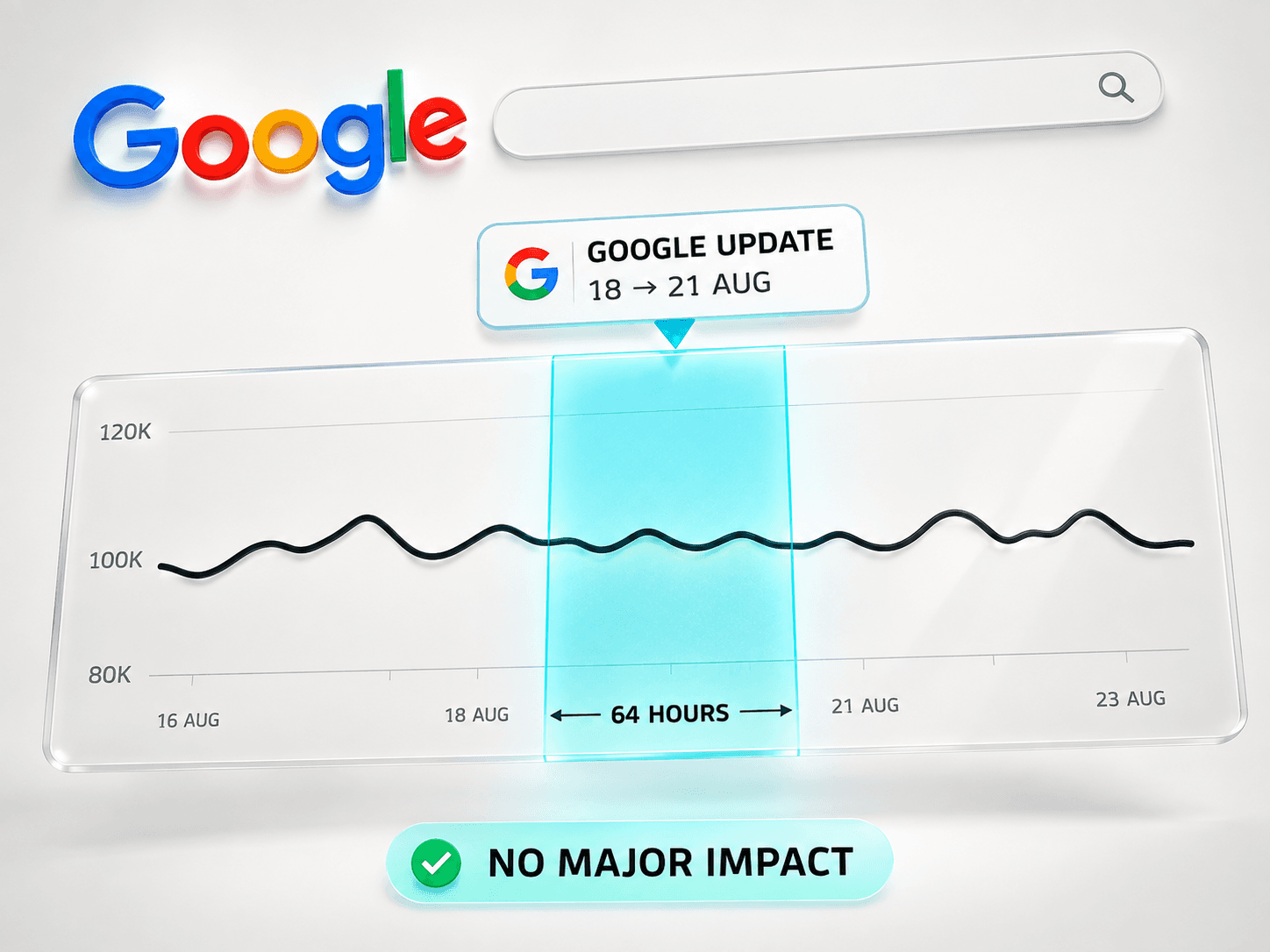
From August 18 to 21, Google rolled out a global spam update, across all languages. According to SE Ranking's analysis of 100 000 keywords, 16.71 % of URLs that were in the top 10 dropped beyond position 100, against 9.2 % in a normal period. That is 82 % more falls. None of the twenty sectors tracked was spared.
On August 26, Google started routing result links through a google.com/goto redirect, which disrupts rank tracking tools.
On August 28, the day of the European announcement, Google confirmed that it now expands some AI summaries to full length automatically, with the follow-up question box already open. Organic results move down another notch.
In France, AI Overviews launched on July 22. On August 11, the press publishers' alliance filed a complaint with the competition authority. The loop closes neatly: AI summaries shrink publisher traffic, lost traffic pushes publishers towards affiliate revenue, affiliate revenue triggers Google's penalties, the penalties trigger the European complaint, and Google retreats on penalties in the same week it accelerates on AI summaries.
What this changes for your site#
Three things worth keeping, and none of them is a green light.
The penalty did not disappear, it changed shape. Inside the EEA, Google can now separate the affected section from the main domain. Its documentation says so directly: the presumption that a page inherits the domain's quality no longer applies, and its systems learn over time to rank each part independently. In other words, the page loses the borrowed authority, which was precisely what the whole operation was after. The sharpest summary we have read comes from PPC Land: one is an intervention against a ranking, the other is the withdrawal of a subsidy. The economic outcome is close. Only the brutality differs.
This new penalty is invisible. It is notified nowhere, it does not appear in Search Console, and Google specifies that it is not automatic. A European publisher can neither know whether it applies, nor contest it, nor measure it. Which is somewhat ironic, since opacity is exactly what the Commission held against Google.
The United Kingdom and Switzerland are not part of the EEA. A site targeting those markets stays fully penalised there. Segment your reporting by country before drawing any conclusion, otherwise you will read a geographic difference as a recovery.
Any measurement taken this week is contaminated. Three variables are moving at once: the spam update, the link redirects that disrupt tracking tools, and the European change. Isolating anything will take several weeks and country-level segmentation.
Then there is the deeper question, the one that should interest anyone who builds websites. Google has now publicly demonstrated that its anti-spam rules are negotiable under regulatory pressure, and technically separable by region. It had always given two answers to anyone who asked: this is about quality, not competition, and it would be technically unworkable. Both answers just fell. Every regulator watching now has a template.
For a business website, the conclusion is flat and solid. A position built on this kind of arbitrage depends on a negotiation between Brussels and Mountain View that you have no say in, and whose next step is unwritten. The proceedings opened in November 2025 are not formally closed. What actually belongs to you is your foundations: a fast site, content someone has a reason to cite, a brand people search by name. Less spectacular, and it depends on nobody.
Want to talk it through?#
If you are wondering where your visibility stands after this August, we can look at it together. Tell us in a couple of lines what you have in mind.
Let's talk about your projectFrequently asked questions#
Comments
No comments yet. Start the conversation.