August 2026 spam update: 64 hours, and nothing for most sites

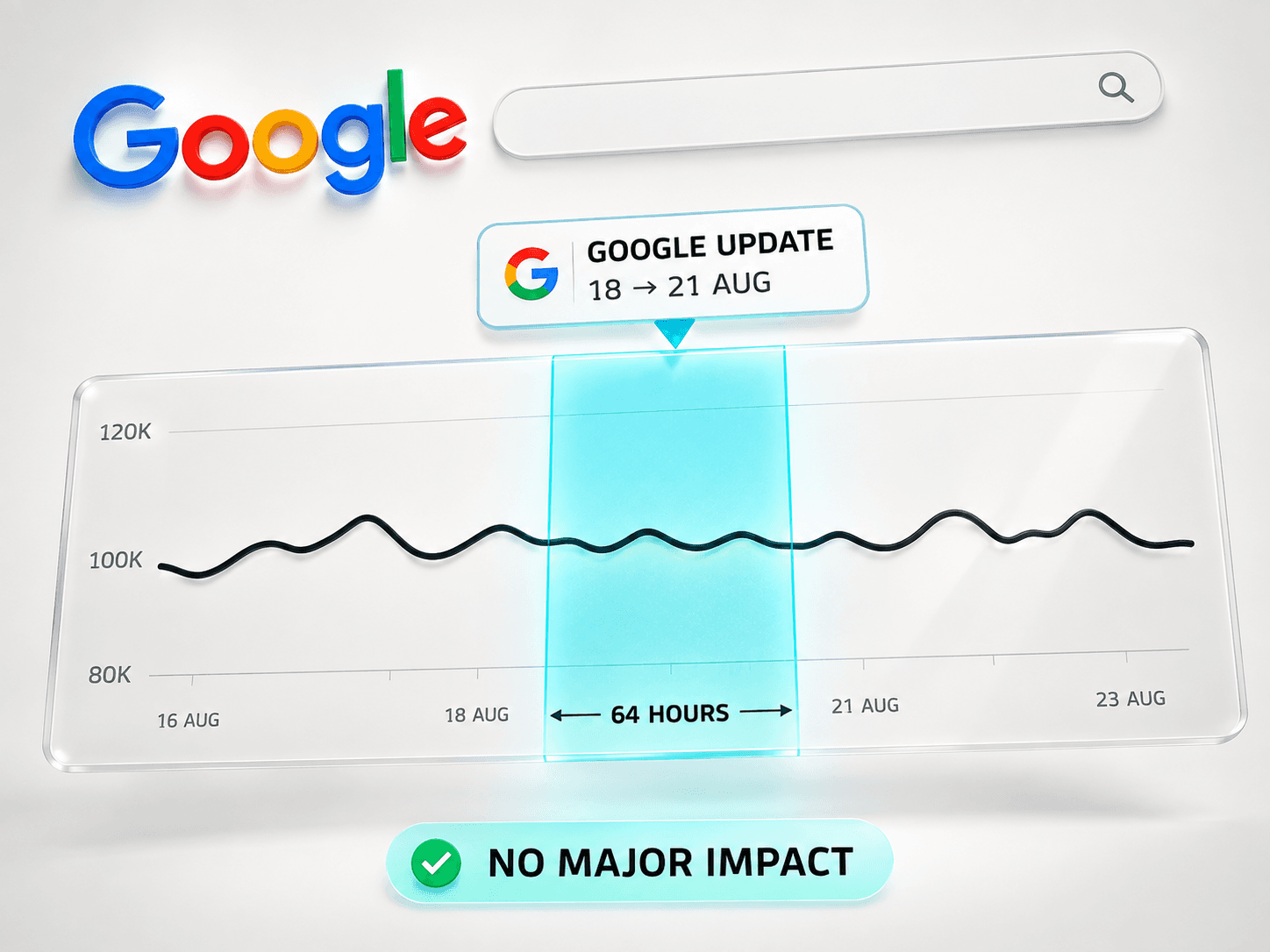
Your traffic moved and you are looking for someone to blame. Short answer: in the vast majority of cases, the August 2026 spam update had nothing to do with it.
Google opened the incident on 18 August at 9:27 a.m. Pacific and closed it on 21 August at 1:49 a.m. That is 64 hours, and nothing for most sites.
Here is how to check that on your own site, in ten minutes.
In this article#
- The facts, to the minute
- Google is getting faster
- A spam update is not a core update
- What it targets, what it leaves alone
- AI writing, and the AI Overviews question
- The early-August turbulence that had nothing to do with it
- How to read your numbers, in order
- If you were really hit, count in months
- The most common cause, and it is not Google
- When looking is a waste of your week
The facts, to the minute#
Google launched the August 2026 spam update on 18 August at 9:27 a.m. Pacific, which is 12:27 p.m. Eastern. The incident closed on 21 August at 1:49 a.m. Pacific. Total: 2 days and 16 hours, worldwide and across every language.
This is the third anti-spam update announced in 2026, after March and June. Google published no new policy and no blog post for it: one LinkedIn post, one message on X, and the entry on its status dashboard. On that dashboard the company says there is nothing new here. It is simply running the same thing again.
Keep those two dates. Everything below depends on them.
Any traffic movement before 18 August 2026 at 9:27 a.m. Pacific has nothing to do with this update. If your curve broke on 3 August, look elsewhere. Date it before you conclude.
Google is getting faster#
This is the real change of the year, and almost nobody covered it. A spam update used to take a month to roll out. It now takes two or three days.
| Update | Rollout | Duration |
|---|---|---|
| August 2025 | 26 August to 22 September 2025 | 27 days |
| March 2026 | 24 March 2026 | 19 h 30 |
| June 2026 | 24 to 26 June 2026 | 2 d 1 h |
| August 2026 | 18 to 21 August 2026 | 2 d 16 h |
One anti-spam update in all of 2025. Three in five months in 2026.
Two consequences for you. The good one: when things move, it is over in three days. You no longer hold your breath for a month. The less good one: quiet windows between rollouts are disappearing, and pinning a drop on one specific update is getting harder.
Which is why you annotate your dates.
A spam update is not a core update#
The confusion is expensive, so let us clear it now.
A core update re-judges which pages best answer a query. It reshuffles perfectly honest sites, and the only answer lies in the content itself. That takes months.
A spam update enforces rules written down in Google's public anti-spam policies. If you are not breaking them, it is not meant to touch you.
The diagnosis differs, and so does the fix. Confusing the two means rewriting a site that never had a content problem.
Rule of thumb. A core update re-judges quality. A spam update enforces a rulebook. You do not answer a rulebook by rewriting your copy.
No setting covers this.
What it targets, what it leaves alone#
Google's anti-spam policies are public and take twenty minutes to read. The practices involved are concrete:
- content produced at scale with no value of its own, including pages spun from a single template,
- duplicated content, or content copied from other sites,
- text stuffed with repeated keywords,
- doorway pages and cloaking, which show one thing to Google and another to the visitor,
- redirects that send people somewhere other than what the result promised,
- expired domains bought to harvest their reputation.
Google was specific about what this update does not target:
- link spam,
- site reputation abuse, meaning third-party content hosted on a trusted domain.
Both have their own updates, and both will come back.
Rule of thumb. The test is the output, never the tool that produced it. A useful page passes. An empty page does not. The rest is noise.
AI writing, and the AI Overviews question#
The question comes up with every update, so let us settle it once.
Rule of thumb. Since 15 May 2026, Google's anti-spam guidelines formally cover any attempt to manipulate generative answers.
Nothing in the August update targets AI writing as such. What the algorithm hunts is scaled content abuse. Whether an empty page was written by a tired human or by an automated prompt, the outcome is the same: it gets dropped.
AI Overviews finished their European rollout this summer, reaching France on 22 July 2026. Forcing your way into a generative answer now carries the same penalties as classic spam.
That is the real story of this autumn. Not last week's update.
The early-August turbulence that had nothing to do with it#
This is the worst-reported part of the month. Tracking tools recorded heavy movement from 1 to 8 August, followed by indexing slowdowns around 5 August. That is ten days before the update was announced. Google confirmed the two are unrelated.
Publisher reports from that window contradict each other, and that is the most useful signal in the whole story:
| What was reported | What it means |
|---|---|
| Up to 70 % of traffic gone, then back to normal within days | A temporary shake, not a demotion |
| Rankings up, traffic down 14 % | The result layout changed, your position did not |
| Traffic moving, rankings flat | The cause is probably outside Google Search |
Three sites, three stories, no confirmed update. Half of what you read in August is not about the spam update at all.
How to read your numbers, in order#
Google gives one piece of advice that sounds obvious and is not: separate your sources before you touch anything. Here is the order we go through your numbers when you call us after an update.
Wait 48 hours
Search Console reports with a two to three day delay. Reading the curve on the day itself means reading an incomplete one, and drawing conclusions from a gap.
Date the drop to the day
Performance view, Date dimension. Write down the exact day the curve breaks. If it is before 18 August 2026, the spam update is out of the picture and you just saved a week of pointless work.
Separate impressions from position
A page can lose 75 % of its impressions without losing a single position. That happens when Google tightens how a query is displayed. It is not a demotion, and the answer is not the same.
Separate branded from non-branded traffic
A drop on your company name and a drop on generic queries almost never share a cause. Filter both before you conclude.
Look at it by directory
A drop spread across the whole site and a drop concentrated in your blog tell different stories. Filter by page.
Open the manual actions report
Search Console, Security and manual actions. A penalty applied by a human is written there with its reason. Careful with false relief: an empty report only proves no human penalised you. It does not prove the algorithm left you alone.
Delete nothing for three weeks
The most expensive move after an update is a mass page deletion, triggered by a drop that would have healed on its own in ten days.
A volatility tracker such as Semrush Sensor or MozCast will tell you whether your whole sector moved at once. If it did, this is not about you.
If you were really hit, count in months#
This is the part nobody enjoys writing, and it is the one that saves your autumn.
A fix applied today does not show next week. A demoted site stays demoted until Google's systems see the change hold, and that is measured over time. Recovery usually lands with the following update. Count in months.
Rule of thumb. Cleaning up lifts the penalty, it does not hand back the rankings. What was won with bought links never comes back.
That is also why we do not sell that kind of shortcut.
The most common cause, and it is not Google#
When a page earns nothing, the reason is rarely algorithmic. It is almost always dumber, and thankfully so, because it gets fixed the same day.
Google does not know the page exists. It responds, it is linked from your menu, and yet it is not in the index. The classic case is a sitemap file that has not been re-fetched in weeks: your site publishes sixty addresses, Google knows forty. URL inspection settles it in ten seconds.
The page was just indexed. A new page almost always lands between the seventh and tenth page of results, on positions that swing from one query to the next. That is not a bad ranking, it is a trial run. Give it three weeks.
The page ranks well and nobody clicks. Here the problem sits in the title and description shown in the results, not in the ranking. It is the most profitable thing to fix, and the most often ignored.
One technical detail blocks everything. A canonical tag pointing elsewhere, a title duplicated across forty pages, a page three times too heavy on mobile. You see it in a minute.
Three causes out of four have nothing to do with this month's update.
When looking is a waste of your week#
There are situations where a week spent in Search Console will earn you nothing. We say so on the first call.
- Your site is under three months old. Google is still exploring your domain. Positions are unstable by design, and nothing you conclude today will hold in October.
- Your clients come by word of mouth. If your business runs on referral, a position on a generic query changes nothing about your revenue.
- You sell to fifteen named accounts. Google Search is not your lever. A phone call is.
- You have published nothing in six months. The update is not your problem, and you already know it.
In those four cases your time is better spent elsewhere. And if an off-the-shelf tool is enough to track your visibility, we will tell you that too.
Check a page before you blame Google#
Most of the questions above come down to what a page actually gives Google to read. That is why we built the workshop's analyser.
You paste an address. It reads the page the way Google reads it, and hands back what is blocking: title, description, heading structure, images with no alt text, weight, structured data, canonical tag.
Free, no account, no email asked. It does not replace your Search Console: it tells you what your page is made of, before Google has filed it anywhere.
And if your problem is somewhere else, it will tell you that too.
Analyse your pages for freeFrequently asked questions#
On the same topic#
- AI Overviews in France: what changes for your site
- Rank higher on Google: 7 simple tips
- Next.js 16.3: what actually changes for your site
Comments
No comments yet. Start the conversation.