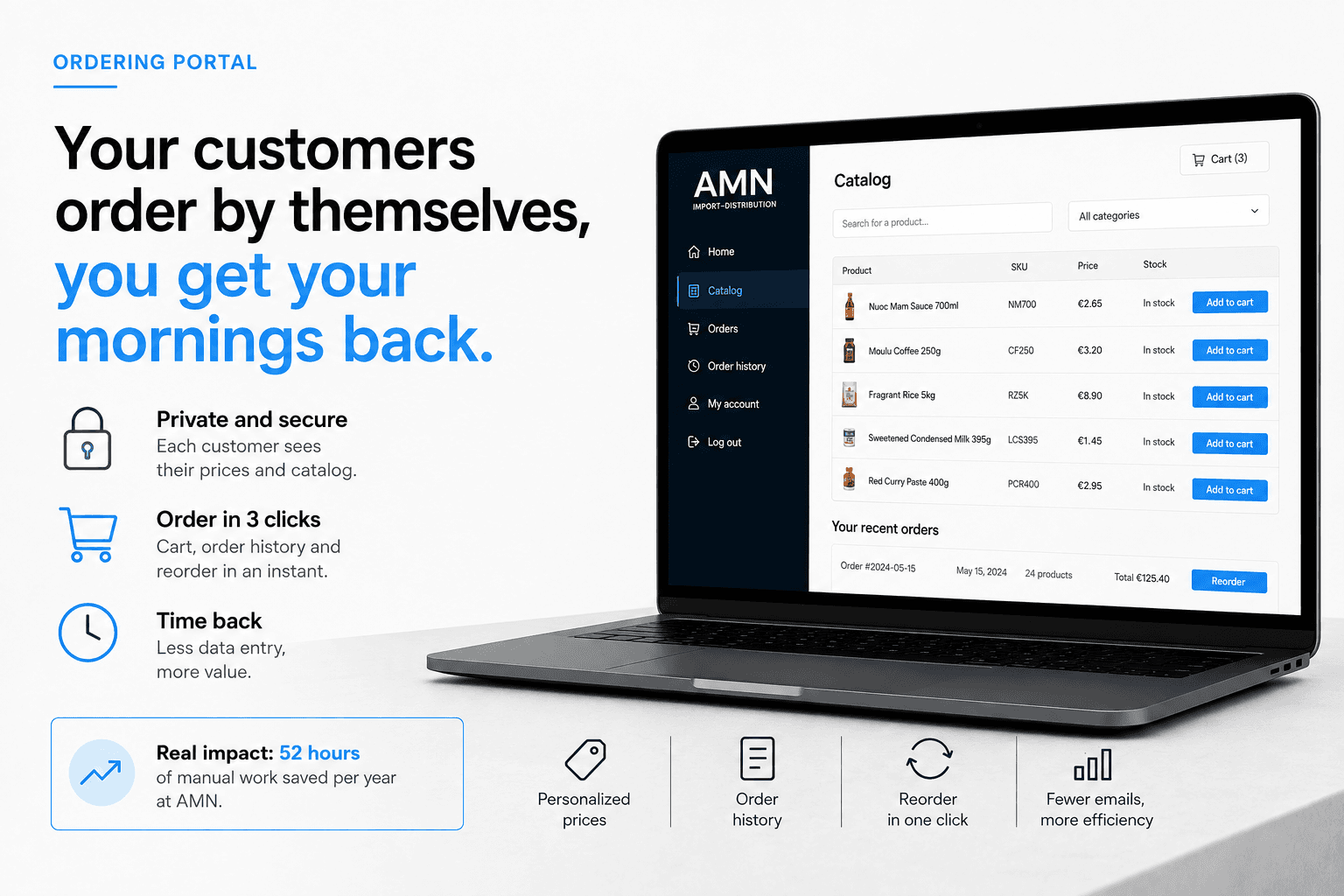
Custom order portal: 52 hours back every year

Custom order portal: let your clients order on their own#
One client messages you on WhatsApp to ask for a price. Another emails an order with no reference numbers. A third calls to check whether you still have stock. You answer every time, and every time you open the same spreadsheet. A custom order portal exists so those three messages never reach you again.
What a custom order portal is#
It is a private area of your website where your trade clients place their own orders. Each one logs in, sees your catalogue with their own prices, adds to a cart and confirms. The order lands with you complete, with the right references and the right quantities.
Three things set it apart from a regular online shop. Prices are not the same for everyone. Clients are identified before they see anything. And last week's order can be repeated in one click, because in B2B people buy the same things again and again.
It is not a client portal#
The two get confused often, and the mistake is expensive, because they solve different problems.
A client portal is for looking things up. Your clients find their invoices, the progress of their files, their documents. It clears the admin questions out of your inbox.
An order portal is for buying. It carries a catalogue, negotiated prices, a cart and an order history. It clears the orders themselves out of your inbox.
Plenty of businesses need both. But if you can only build one, pick the one that handles whatever eats your time today.
What changes, with a real case#
AMN Import-Distribution is the leading online distributor of French products in Cambodia. Before, prices lived in printed catalogues that aged badly, and orders arrived by messaging app.
We built their order portal around 749 imported products. The measured result: 52 hours of manual work removed per year, roughly a week and a half handed back to the team. Prices now update everywhere in a single move, instead of reprinting a catalogue.
Let us be precise about what changed and what did not. Orders by messaging app did not disappear, some clients prefer them. But for three clients out of four, the back and forth about prices and stock did disappear.
When it is not worth it#
An order portal is not always justified, and it is better to know that before spending.
If every client pays the same price, if your catalogue fits on one page, and if your clients order twice a year, a standard online shop will do the job for far less. Shopify exists, it is very good, and we will tell you so on the first call if that is your situation.
A portal pays off when three conditions meet: prices that vary by client, orders that come back often, and someone on your side spending their mornings retyping them.
Cost and timeline#
A focused automation, for instance pulling in orders received by email, starts at €4,000 and ships in 2 to 3 weeks.
A full portal, with catalogue, per-client pricing and order history, is quoted per project. Expect 2 to 4 months depending on its size. The fixed price and the delivery date are written down before we start, and payment is split in three: at kick-off, midway, and on delivery.
And then you are free#
The tool is yours. You add a product, change a price, open a client account without calling us and without a line of code. You have 14 days after delivery to request changes covered by the price. After that, each evolution is quoted separately, and you are free to hand it to whoever you like.
Comments
No comments yet. Start the conversation.